

About
I AM AN 80 YEAR OLD MALE, BORN AGAIN, CHRISTIAN WITH A LOVE FOR JESUS. I DO NOT GET OUT MUCH ANYMORE BUT FIND THAT TELLING PEOPLE ABOUT THE LOVE JESUS HAS FOR THEM IS NOT ONLY WHAT WE ARE SUPPOSED TO DO BUT SOMETHING THAT THE WORLD NEEDS.
Website
Location:
Zipcode: 32934
Country: US
Stats
Profile Tag Cloud:
Category: INSPIRATIONAL

Jesus told His disciples many times of His death but this is the first time He indicated the reason for His death. Now it is clear that His death would be a "ransom", defined in the Greek as a means of loosing by paying a price.
The words "ransom" and "redeem" were used interchangeably in scripture.
Not only would Jesus pay the price for sin but also His death would be substitutionary. In 1 Timothy 2:6, the word "ransom" is taken from the Greek word "antilutron" which means "a redemption-price." The Greek word "anti" means "in place of." In other words, the ransom avails for all who will accept it (Jn. 3:16; Rom. 10:13).
The price paid for our redemption is the life of Jesus, that is, Jesus' blood (Col. 1:14). This redemption, according to...

NOW, ALTHOUGH WE ARE NEW CREATURES IN OUR SPIRITS, OUR OLD CARNAL MINDS HAVE NOT BEEN RENEWED AND IT IS UP TO US TO RENEW THEM. PAUL TELLS US IN...

The Greek word for baptize is "baptizo." This word was used by Plato (fourth century B.C.) to describe a man being "overwhelmed" by philosophical arguments; or it means sponges being "dipped" in fluid; and by Strabo (first century B.C.) to describe people who could not swim as being "submerged" under water. Josephus in the first century A.D. used the word to describe the city of Jerusalem as being "overwhelmed" or "plunged" into destruction by the Romans; and Plutarch (also first century A.D.) used this word to refer to a person being "immersed" in the sea. In the Septuagint (the Greek version of the O.T.), "baptizo" is used to describe Naaman dipping...

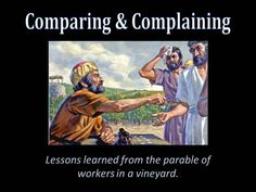
This parable begins with Jesus' statement that the kingdom of heaven is likened to a man who is a householder (owner of an estate). He went out early in the morning to hire workers to work in his vineyard for the day. An agreed upon price was set at a penny, the normal wage paid daily for a laborer. Later, around 9 a.m., the landowner encouraged others, standing idle in the marketplace, to work in the vineyard, not for a set wage but for "whatsoever is right." The landowner employed more laborers at noon, at 3 p.m. and even some at 5 p.m. when there was only one hour left to work.
According to Jewish law, wages must be paid each evening before the sun sets. When it came time for the steward to...

Notice that the scripture makes special mention of Jesus loving this rich young ruler. This is stated after this young man said he had kept all of God's commands, which was not the truth. Jesus was showing him that he had broken the very first commandment that states, "Thou shalt have no other gods before me" (Ex. 20:3), and also the tenth commandment that says, "Thou shalt not covet..." (Ex. 20:17). Jesus' tough answer of "sell whatsoever thou hast, and give to the poor" was not intended to hurt this young man. It was said from a heart of love and intended for his own good. This man's money had become his god and it had to be dethroned...


On the surface, it appears that this rich young ruler was "right on" in the way he approached Jesus and sought salvation. He ran, kneeled down to Jesus, and openly professed Him as a Good Master. What could be wrong with that?
First, he acknowledged Jesus as good but not as God. This is a pivotal point.
Every major religion of the world acknowledges that Jesus lived and will even admit that He definitely was a good man, but they won't recognize Him as God. If Jesus was only a good man, He couldn't save anybody. Jesus didn't just come to show us the way to God. He was the way, the only way unto the Father.
No man could come unto the Father, but by Him (Jn. 14:6). Jesus had made this point publicly many times before. This is...

Although adultery denotes one who has unlawful intercourse with the spouse of another, in its much broader term, it means to violate or pollute. Israel violated or polluted their covenant with God. Jeremiah says, "She (Judah) defiled the land, and committed adultery" (Jer. 3:9).
Adultery in relation to marriage also reflects a violation of the covenant of companionship. Sex outside of marriage is adultery because it violates or pollutes the covenant of marriage by introducing another party and bringing that relationship into the marriage. "They two shall be one flesh" (Eph. 5:31).
Divorce also adulterates or pollutes marriage because it disrupts or...